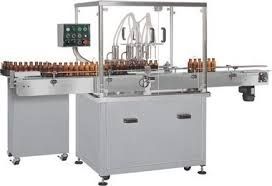
About Tin Oil Filling Machine
Description:
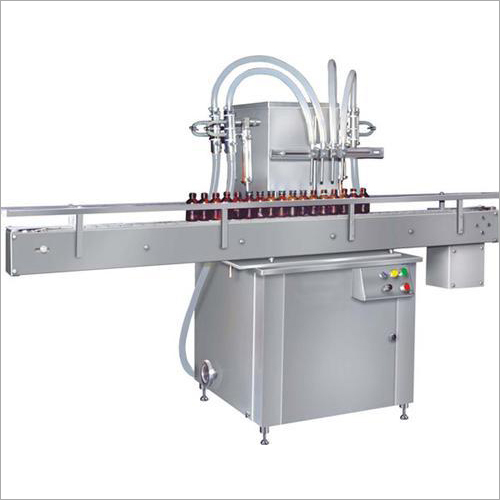
- Automatic Volumetric Liquid Bottle Filling Machine work on volumetric principle with diving nozzles
- The unit is made compact,versatile and enclosed in stainless steel elegantly matt finish body, of S.S Slat Conveyor, Reciprocating Nozzle with self-centering devices & SS Syringe.
- The main drive of the machine and conveyor drive consist of A/C Motor with synchronized variable A/c Frequency drive
Operation:
- Containers moving on S.S. Slat conveyor, feed below the filling nozzles through a settable pneumatic stopper system.The pneumatic stopper system and reciprocating nozzles can Synchronize for centering of container below nozzles, to avoid spillage of liquid on container
- To minimize foaming adjustable nozzle will reciprocate according to filling dose, nozzle will go upwards slowly from bottom level of bottle towards neck during filling
- The dosing block with a hexagonal bolt fitted below syringes. This means fill size can be easily set
Salient Features:
- +/- 1% Filling accuracy on single dose
- No bottle No filling system
- Rigid vibration free construction for trouble free performance
- S.S. Elegantly matt finished body
- Minimum change overtime, from one size to another container or fill size
- Pneumatic bottle stopping arrangement
- Synchronized two nos. A/c drive for main motor & conveyor belt
Optional Features:
- In-built pre-inspection
- Acrylic cabinet
- Nitrogen Flushing
- Float tank (Holding tank) with or without stirrer
Advanced Automation with PLC ControlFeaturing a user-friendly Programmable Logic Controller (PLC) interface, this oil filling machine ensures consistent, accurate filling operations with minimal manual intervention. Operators benefit from the simple control system, enabling quick setup, monitoring, and adjustment during production runs.
Exceptional Performance and EfficiencyDelivering high capacity processing of 20-60 tins per minute, the machine excels in environments requiring speed without sacrificing precision. Engineered with stable mechanisms, it reduces energy usage and noise, supporting sustainable production and lower operational costs.
Durable Stainless Steel ConstructionManufactured from high-quality stainless steel, the machine resists corrosion and wear, ensuring long-term durability even in demanding manufacturing plants. Easy-to-clean surfaces and robust design make maintenance straightforward, ideal for continuous industrial application.
FAQ's of Tin Oil Filling Machine:
Q: How does the Tin Oil Filling Machine ensure precise filling?
A: The machine utilizes a computerized PLC control system that automates and monitors the filling process. This advanced control ensures each tin receives the correct amount of oil, maintaining consistent product quality and reducing wastage.
Q: What are the benefits of using this oil filling machine for my business?
A: Benefits include high filling efficiency (20-60 pcs/min), eco-friendly operation with low noise and energy use, easy computerized controls, sturdy stainless steel construction, and reduced labor costs due to full automation.
Q: When is the Tin Oil Filling Machine most suitable for use?
A: It's best used in industrial settings requiring fast and accurate oil filling such as food processing plants, edible oil manufacturers, and packaging enterprises seeking reliability and output consistency.
Q: Where can this machine be installed and operated effectively?
A: Designed for adaptability, the machine fits well into medium to large-scale production lines in factories across India. Its compact 2400 x 1200 x 1400 mm footprint allows for seamless integration into existing setups.
Q: What is the process for operating the Tin Oil Filling Machine?
A: Operation is straightforward: Connect to a power supply (220V), configure the filling parameters using the PLC interface, load the tins, and initiate the automated filling cycle. The system monitors and controls the process, requiring minimal supervision.
Q: How does the automatic grade feature add value to users?
A: Its automatic grade ensures continuous operation, reducing manual intervention, increasing productivity, and minimizing the risk of human error, all while maintaining high filling precision and efficiency.




 English
 Spanish
 French
 German
 Italian
 Chinese (Simplified)
 Japanese
 Korean
 Arabic
 Portuguese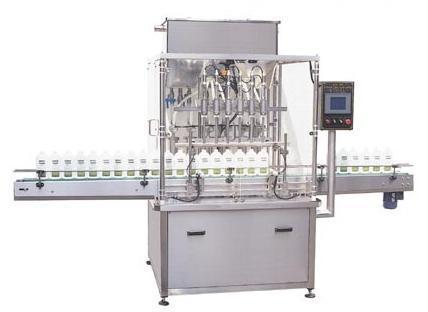

 Send Inquiry



 Send Inquiry
 Send Inquiry
 Send SMS



